For most social listings, start with a 9:16 vertical master, keep the total reel around 15–30 seconds, and give every shot enough time for a viewer to understand the space. The exact duration matters less than the relationship between the visual, the text, and the next action.
Which aspect ratio should a real estate reel use?
Use 9:16 for Instagram Reels, TikTok, and YouTube Shorts. It fills the phone screen and leaves room for a readable hook, but keep important information away from the top, bottom, and right-side interface areas. Use 16:9 for a listing page, email, presentation, or any placement where a wide frame is the natural fit. A square export is useful for some feeds, but it should be a deliberate adaptation rather than the master.
Do not solve a crop problem by allowing the frame to invent more of the room. If the source photo is wide, preserve the visible composition, use a tasteful crop or background treatment, and make sure the property remains the same property.
How long should each shot stay on screen?
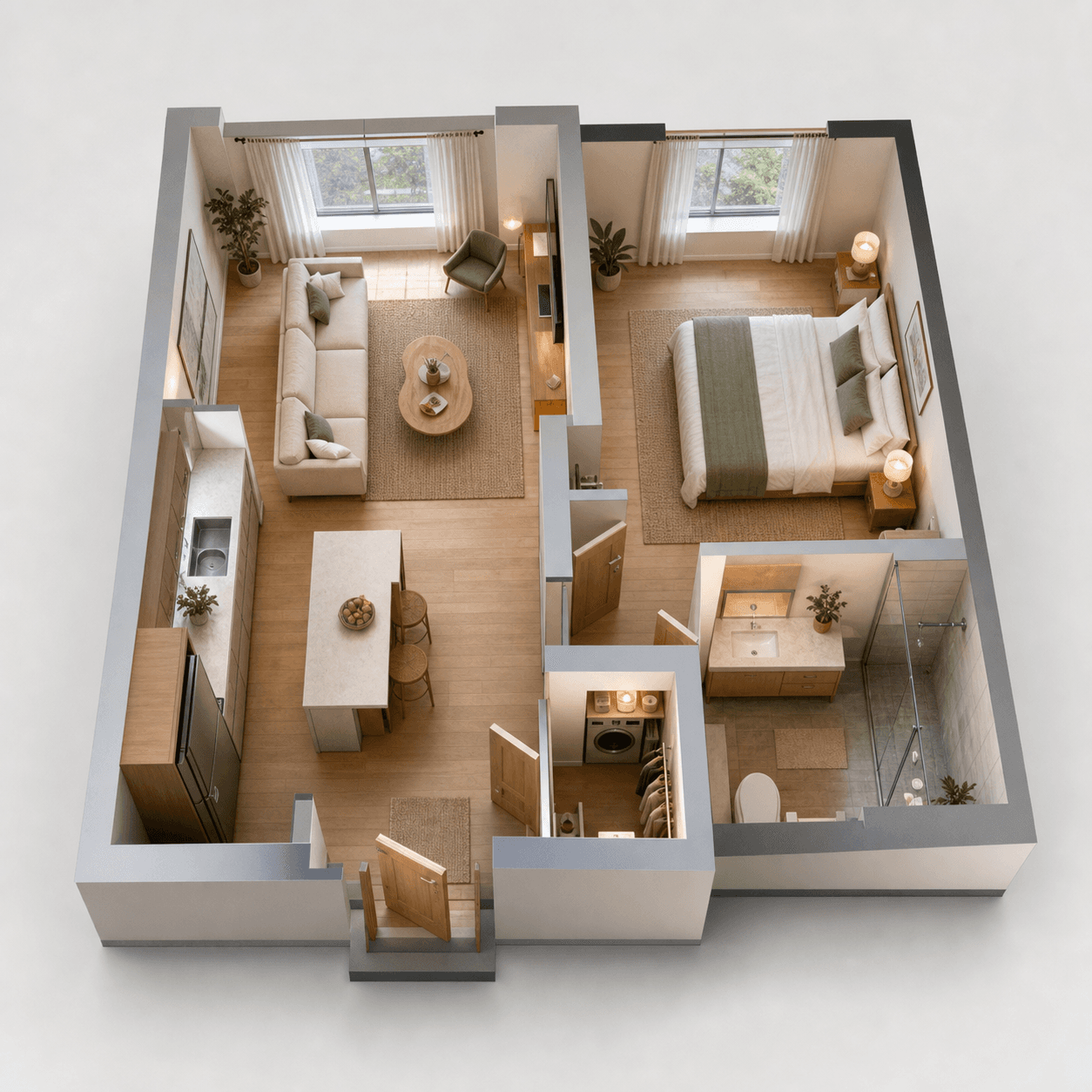
Give a hero shot roughly three to four seconds, supporting rooms two to three seconds, and a final call-to-action card at least two seconds. A six-shot reel can therefore land comfortably around 18–24 seconds. Slow down when a floor plan, room relationship, or text overlay needs reading time. Speed up only when the image is self-explanatory.
Shorter is not automatically better. A buyer who cannot orient themselves will remember the edit as noise, not as a home.
What structure works for a listing reel?
- Hook: the most distinctive, truthful visual or a specific buyer question.
- Context: one verified detail such as “two-bedroom near the park.”
- Proof: two to four images that explain the layout, light, storage, or outdoor space.
- Next step: tour link, open-house time, or a message prompt.
Do not open with a logo animation unless the brand itself is the reason the viewer is watching. The property should earn the first second.
How much text belongs on screen?
Use one idea per frame. “Flexible second bedroom,” “south-facing garden,” or “open Saturday” is easier to read than a paragraph of listing remarks. Keep type large enough for a phone, use strong contrast, and avoid placing copy over busy furniture or windows. Captions and sound-off context are not decoration; they are how many viewers understand the reel.
How should the caption change by platform?
- Instagram: lead with the feature, add location and approved facts, then invite a save, share, or tour enquiry.
- TikTok: write conversationally, repeat the searchable property phrase in on-screen text, and ask a genuine question.
- YouTube Shorts: make the title descriptive: property type, neighbourhood, and the distinctive feature.
- Listing page: prioritise accurate specifications, accessibility, and a direct contact path over hashtags.
Pre-publish quality check
- The first frame explains why the viewer should continue.
- Every movement stays inside the source photo's visible geometry.
- Price, status, dimensions, and event details are current.
- Text is readable without sound and clear of platform controls.
- Altered or virtually staged visuals are identified where required.
- The final frame tells the viewer exactly what to do next.
Use the photo-to-reel workflow when you need a sequence from existing listing images, then adapt this specification for each destination rather than publishing one file everywhere unchanged.